
Part I: The Basics:
Statistics and Figures of Merit
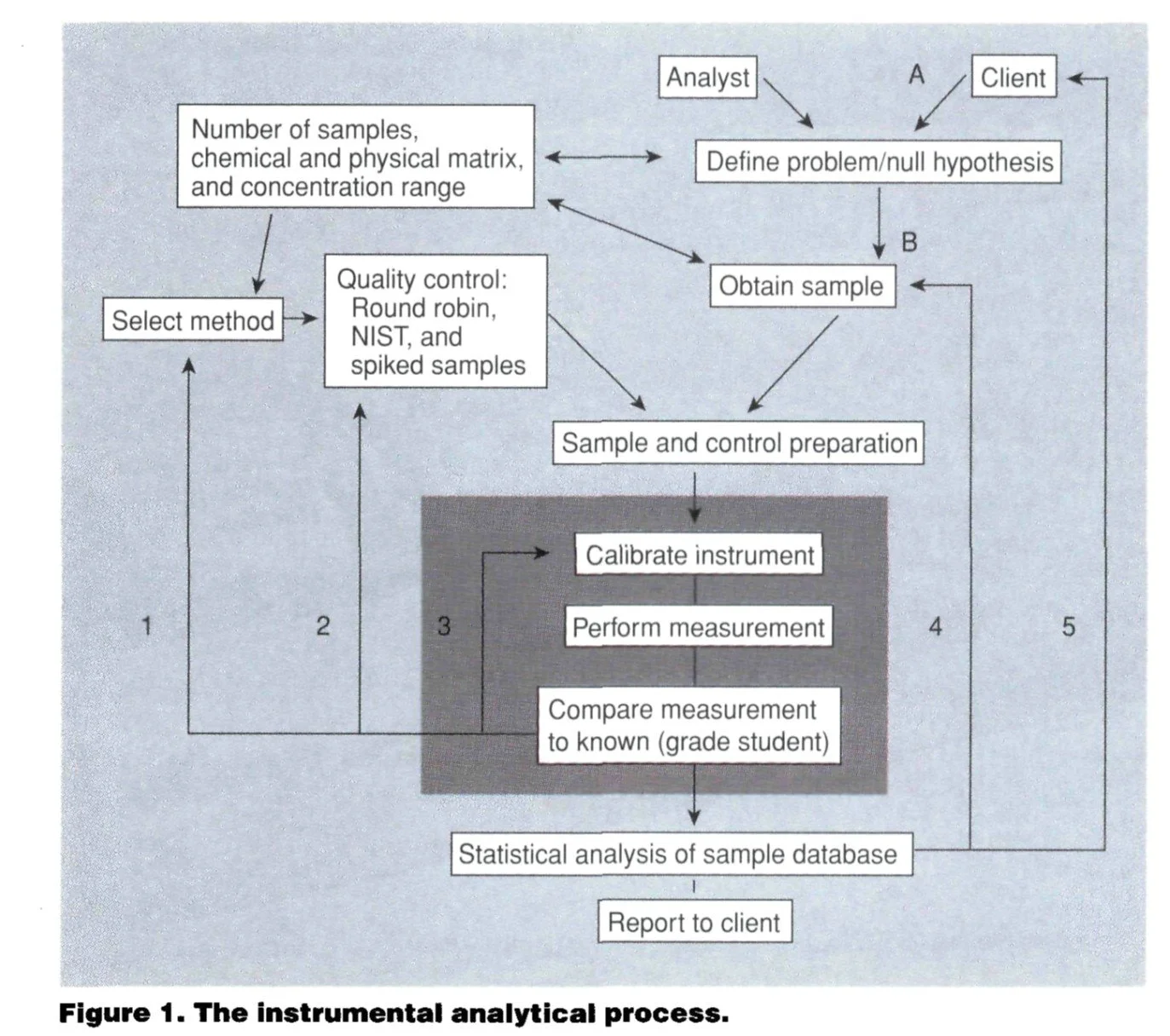
In order to chose a method, which is just one part of the analytical process (see Figure), one must have some agreed criteria against which to evaluate that method for comparison with others. The criteria are general the Figures of Merit (FOM) by which a particular method may be judged.
By using a single analyte teaching lab (lead lab) the Figures of Merit become emphasized as an analytical tool.
The main FOM are limit of detection (LOD), limit of quantification (LOQ), and sensitivity (change in signal per change in concentration), linear range all parameters of a calibration curve. In order to have data that results in good calibration curves are selectivity, related signal to noise ratio (S/N), precision, and accuracy. Other consideration are time required to make the measurement (rise time). Even more it important may be issues related to cost of the instrumentation and its maintenance.
Nearly all of the FOM are grounded in statistics so this section begins with 1. statistics, moves on to obtain good data for a calibration curve, then heads back to 4. QC (precision and accuracy), Sampling (grounded in statistics), and preparation which affects selectivity. Finally one is ready to take on Calibration Curves (5-8) and then using the FOM obtained select a quantitative method after obtaining the FOM from each quantitative method (Part II).